
Release notebook · 28 September 2026
SSTV 2.0 anniversary edition
A received picture rarely ends the experiment. There is a recording to keep, a station to log, another pass to plan, and sometimes a different kind of signal to identify. The anniversary edition brings those jobs into one station workspace.
More than an analog picture decoder
Martin, Scottie, Robot, PD and the other analog families remain in the mode library. Version 2.0 adds three receiving paths with different technical requirements: SSDV packet images, monochrome Weather Fax scans and the ETSI Digital Radio Mondiale system.
SSDV reception starts with a supported AFSK, FSK, BPSK or I/Q profile and only reaches a picture after link frames and image packets are recovered. Weather Fax uses an operator-selected line rate and IOC. DRM adds OFDM acquisition, multiplex signalling and digital service recovery; Modes A-D use the DRM30 path, while Mode E needs wideband complex I/Q.
The protocol guide compares those paths without folding them into the analog VIS table. The new sample library provides complete image waveforms, telemetry fixtures and calibration strips for each receiving task.
A receiver that can follow the radio
A microphone is still useful next to a handheld's speaker. For a fixed station, 2.0 can also receive from local audio devices, replay recordings, or connect to rtl_tcp, SoapyRemote and SDR++ servers. Native Mac users can select a Core Audio device or a supported direct USB RTL-SDR.
These connections carry samples; the selected decoder determines what the transmission means. The input reference lists the formats, ports and platform differences, including why a Mode E I/Q recording cannot be replaced by a voice-band WAV.
Simple for the first pass, Advanced for the bench
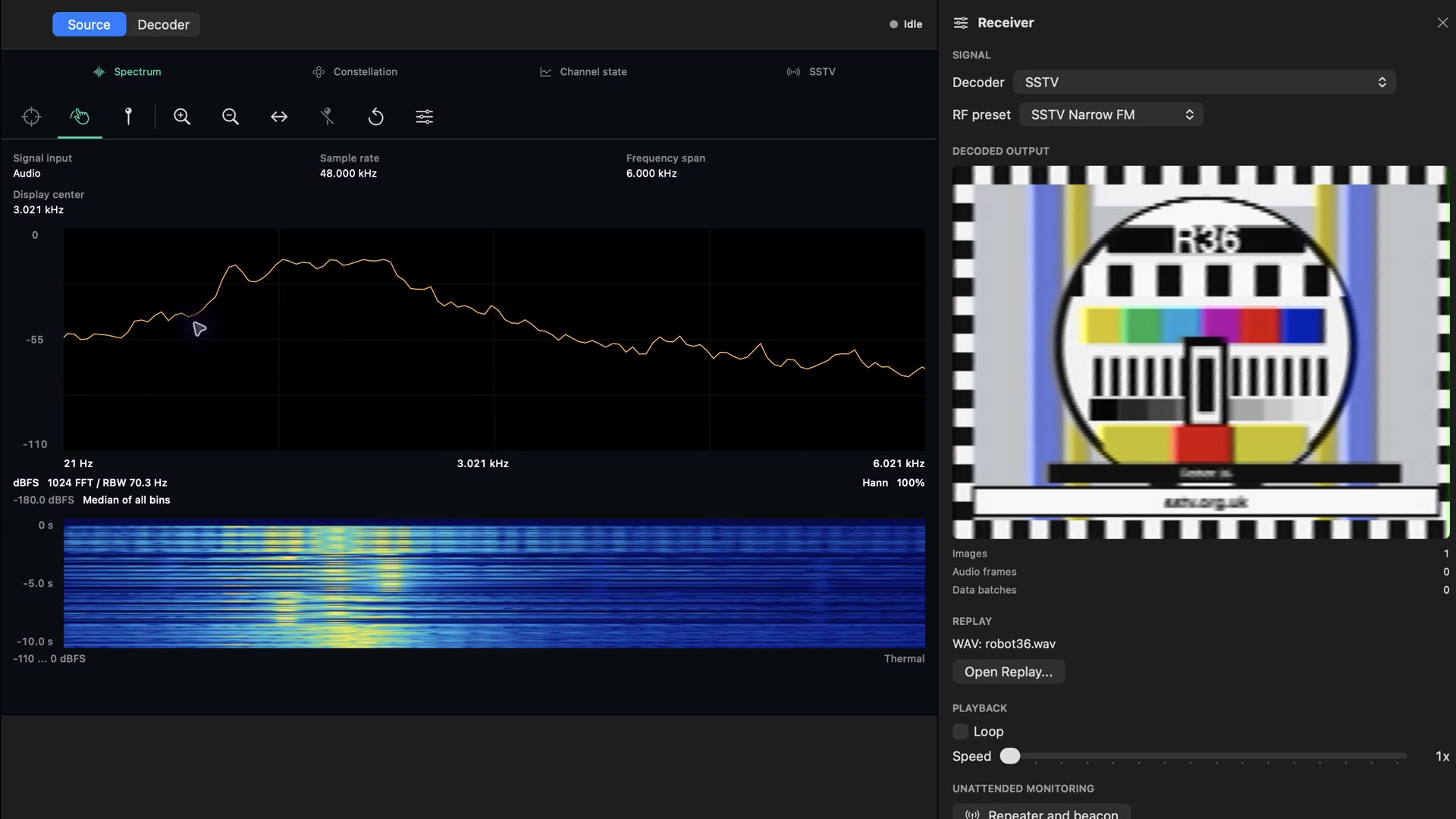
The first-run flow sets up the station and introduces a compact Simple workspace. Advanced mode exposes deeper receive, diagnostic and transmit controls. The iPhone, iPad and native Mac layouts keep the active image, source state and spectrum visible at sizes suited to each screen.
Spectrum and waterfall displays help distinguish a missing source from a mistuned or clipped signal. RX/TX archives retain the products of a session, while the QSO log keeps contact details and station notes attached to the operating record.
Station records across Apple devices
Private iCloud sync carries the station profile, preferences, QSO log, satellite favourites and reminder rules across iPhone, iPad and Mac, including across Pro and Lite. Decoded-image sync is optional and can be turned off in Settings.
Raw audio and I/Q recordings stay local, as do receiver endpoints, calibration values, permission state and purchase state. The privacy policy explains the storage boundary. Keep a local copy of the original recording when the waveform itself is part of the experiment.
Satellite preparation and transmit records
The satellite workspace uses CelesTrak orbit data and SatNOGS transmitter details for pass planning, with favourites, reminders and Doppler-aware tuning through compatible input providers. Public SSTV event announcements remain in the separate activity log; a predicted pass is not an announcement that a transmitter will send SSTV.
Transmit preparation adds callsign overlays, FSK/CW station IDs, templates and automated sequences. DRM image, audio and data payloads have their own waveform presets. Preparing a file and putting it on air remain separate station actions, with the output format and intended service recorded alongside the artifact.
Pro and Lite in 2.0
| Edition | Receiving | Digital and advanced transmit tools |
|---|---|---|
| SSTV Signal Desk | Unlimited supported receiving | Included in the up-front paid edition |
| SSTV Lite 2.0 | Three free SSTV or Weather Fax receives, counted when a supported mode is identified | Permanent Full Unlock enables unlimited receiving, SSDV, DRM and premium transmit tools |
A Lite use is counted at mode identification, even if the signal later drops out. Version 1.x instead included five successfully saved decodes. Basic analog transmit preparation and saving a station callsign remain available without the 2.0 digital/advanced unlock. Read the updated edition comparison.
Release availability
The UK SSTV Signal Desk listing shows version 2.0, released on 27 September 2026. At the 28 September check, the UK Lite listing still shows 1.0.2. The Lite 2.0 features above describe the 2.0 edition; check the version shown in your storefront before expecting them.
8 October update: Lite 2.0 was released on 29 September. Both UK listings now show version 2.0; the earlier availability note records the position when this article was first published.