Frequency-offset search around supported link profiles, followed by normal frame validation.
Automatic selection searches supported candidates. Selecting the known profile limits that search and makes a station log easier to interpret. SatNOGS IQ and Doppler search are acquisition routes, not universal satellite decoders.
1200 AFSK / AX.25
1200 Hz mark and 2200 Hz space; NRZI, HDLC flags, bit stuffing and AX.25 frame check.
SSDV packets in AX.25 UI information fields; source and destination callsigns belong to the outer frame.
The AX.25 frame CRC and the SSDV CRC/FEC protect different layers. A valid radio frame need not contain SSDV.
SSDV with Reed-Solomon FEC
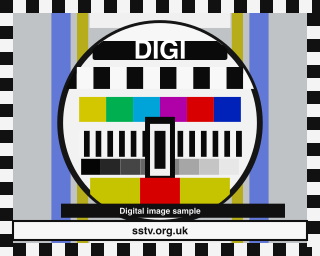
The complete digital test card carried in AX.25/SSDV packets.
Generated by the pinned native transport fixture generator.
Source card; this link fixture does not carry a complete image.
KISS is a separate interface
The shared library includes KISS/AX.25 framing and a TCP helper. The 2.0 app's source picker exposes audio/file input and SDR sample servers, not a KISS TCP source. A Dire Wolf KISS stream is already demodulated frame data; it is not PCM audio and cannot be supplied to the rtl_tcp input.
SSDV packet FEC versus link FEC
The normal SSDV packet has type 0x66 and 32 parity bytes. The no-FEC packet has type 0x67 and a larger JPEG-fragment payload. AO-40 or IL2P error correction, when present, belongs to the outer radio link. Never remove SSDV parity merely because a transport has its own FEC unless the transmitter actually uses the no-FEC packet layout.
Profile names and app entry points were checked against the 2.0 release source on 28 September 2026. The downloads use its pinned RadioSignalKit revision. A telemetry fixture demonstrates a link's framing; only the complete SSDV samples are presented as image-reconstruction examples.