DRM Mode C
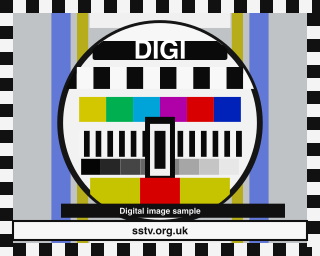
The digital test-card JPEG carried in a DRM MOT image service.
48,000 samples/s · 1 channel · 51.60 s
Generated by the SSTV 2.0 pinned transmitter library; PCM16 WAV verified by its writer.
 SSTV.org.uk
DRM specification · DRM30
Similar to Mode B, but with higher Doppler spread.
Difficult skywave or moving-path cases where Doppler spread matters more than raw throughput.
| Parameter | Value |
|---|---|
| Useful symbol duration Tu | 14.6667 ms |
| Guard duration Tg | 5.3333 ms |
| Total symbol duration Ts | 20 ms |
| Guard ratio Tg/Tu | 4/11 |
| Carrier spacing | 68.18 Hz |
| Transmission frame | 20 symbols / 400 ms |
| Nominal channel widths | 10, 20 kHz |
Wider carrier spacing improves Doppler tolerance, while capacity drops and only 10/20 kHz occupancies are defined.
| Occupancy | Bandwidth | Kmin | Kmax | Unused indices | Occupied positions |
|---|---|---|---|---|---|
| 3 | 10 kHz | -69 | 69 | 0 | 138 |
| 5 | 20 kHz | -67 | 213 | 0 | 280 |
Select DRM Modes A-D. The reference waveform is 48 kHz mono real IF centred at 12 kHz, with 10 kHz spectrum occupancy. A conventional narrow voice filter can truncate this waveform; use a receiver or SDR path with enough bandwidth.
Synchronization identifies the waveform. FAC describes the multiplex; SDC describes services and stream allocation; MSC carries the application data. The image in this sample is an MOT object. FAC lock alone does not prove image recovery, and an audio-only broadcast may provide no image to display.
The digital test-card JPEG carried in a DRM MOT image service.
48,000 samples/s · 1 channel · 51.60 s
Generated by the SSTV 2.0 pinned transmitter library; PCM16 WAV verified by its writer.
The sample uses 64-QAM MSC, 4-QAM SDC and short interleaving at occupancy 3. The payload is a JPEG test card, not a recording of a broadcast station.