
AVT mode
Amiga Video Transceiver AVT104
AVT104 is a reference-only analog SSTV row with 96 s duration, 256 x 256 raster, RGB color model, and VIS not confirmed in checked sources.
Needs verificationMode sample
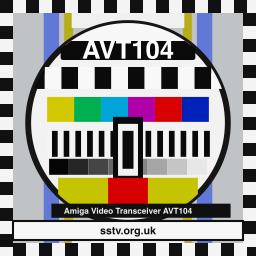
BBC-style colour test card and app-generated audio
The image is generated locally for this mode's raster. For supported modes, the audio sample is encoded from that image with the SSTV Signal Desk transmitter code, then published as lossless FLAC for static playback.
No app-generated audio sample is published for this needs-verification mode because no matching transmitter entry exists in the app code.
Mode spec
| Short name | AVT104 |
|---|---|
| Support status | Needs verification |
| Spec status | Secondary AVT table row. Dayton N7CXI excludes AVT timing tables because it did not have solid author data. |
| Duration | 96 s listed for AVT104 |
| Frame | 256 x 256 |
| Data lines | 256 |
| Public VIS | VIS not confirmed in checked sources |
| Standard VIS code | Not applicable or not published in checked sources |
| Extended/N-VIS | No |
| Color model | RGB |
| Component sequence | R-G-B |
| Line rate | 160 lpm |
| Public timing profile | Secondary AVT table gives 96 s and 256 x 256. The checked Dayton timing paper explicitly excludes AVT modes, so line-level AVT synchronization is not asserted here. |
Strengths
- AVT104 documents a legacy AVT row with 96 s duration and 256 x 256 raster.
- AVT104's R-G-B / RGB listing helps separate the AVT family variants before implementation-level timing is available.
Tradeoffs
- AVT104 has no confirmed VIS in the checked sources, so automatic receiver selection cannot be specified from this row alone.
- AVT104 line-level porch timing remains secondary-source context; treat the 96 s entry as historical, not as an app-supported preset.
Source notes
AVT104 is included from a secondary AVT mode table as 96 s and 256 x 256. Dayton N7CXI is cited only for the caveat that AVT timings were excluded from its proposed specifications due lack of solid source data. Longer AVT mode recorded in SSTV Handbook style mode lists.
- Slow-scan televisionWikipedia - accessed 2026-08-24Secondary reference used only for legacy AVT 8/16/32/48/104 durations and rasters that are not present in the OK2MNM mode-list PDF.
- A Technical Description of SSTV ModesN7CXI Dayton paper - accessed 2026-08-24Classic technical timing reference for Robot, Martin, Scottie, Wraase, Pasokon, PD, and FAX480 families.